Product & Technology Delivery —
“Our toolchain is a mess and nobody owns it.”
Evaluating the toolchain you have, architecting the one you need, and implementing it end to end — from requirement to the product in your customer’s hands.
Most toolchains were bought, not designed. A wiki from one era, a CI server someone stood up for a single project, three test management tools because three teams each chose one, and a release process that depends on a person rather than a pipeline. Every tool works. The chain does not.
The cost is not licensing, it is the gaps between the tools. A requirement that is re-typed into a ticket. A test case that cannot be traced to the requirement it proves. A defect that reaches a customer because the feedback path back into planning is somebody’s inbox.
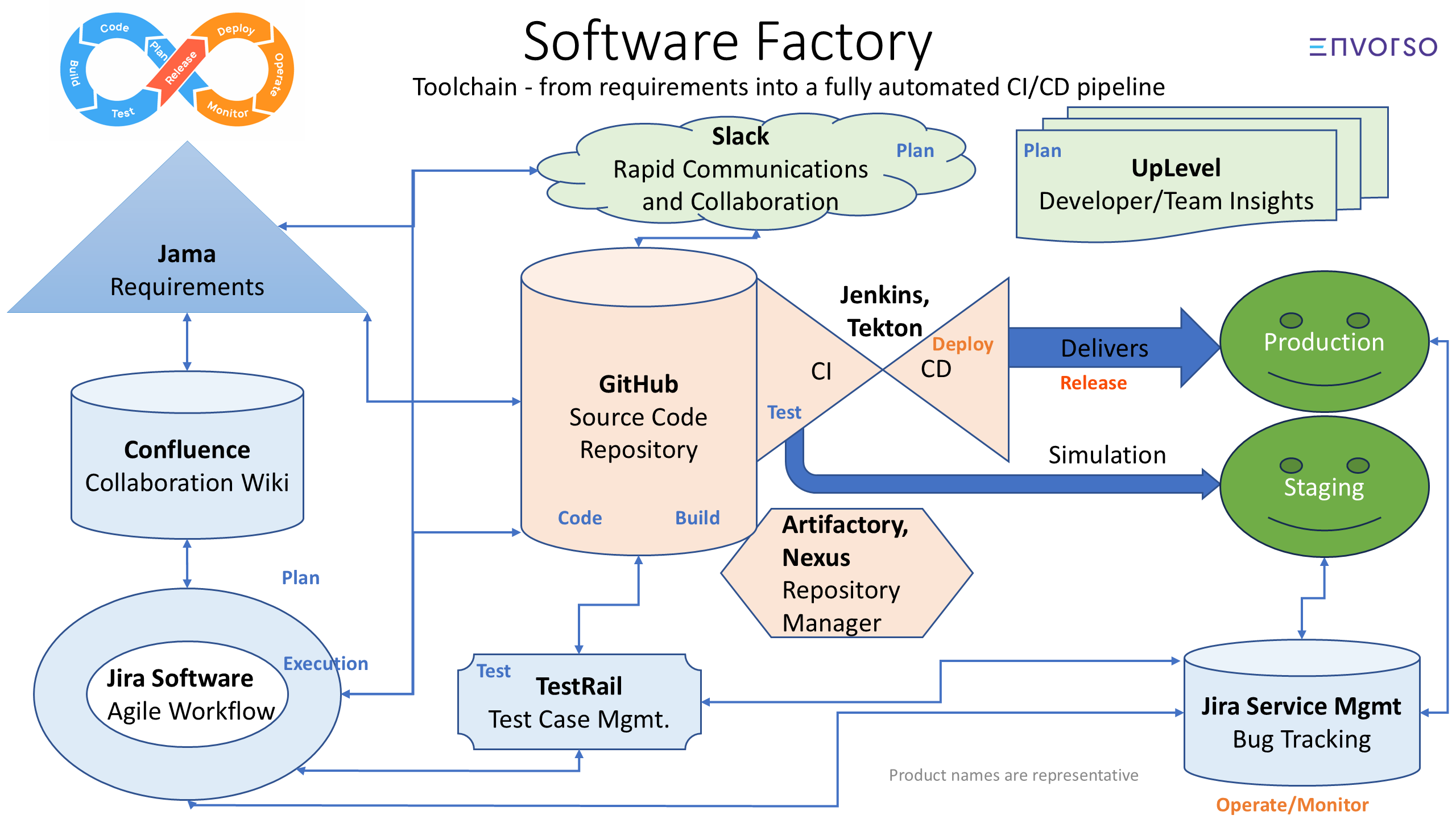
We call the target state a Software Factory: one unbroken thread from requirement to shipped product, and a loop that closes back into planning without human relay. The seven phases below are the same whether you ship vehicles, handsets, or a web platform.
Where AI fits here
Every AI capability you buy runs on this chain. A fragmented one holds you at level 1 because the data cannot be joined, and a model only reaches production — and stays there — if the pipeline can build, test and deploy it like anything else you ship.
The five levels of AI capabilityThe seven phases
One thread, requirement to product.
A chain is only as good as the joins. These are the phases every software organization has, whether or not anyone has designed them — and the categories each one needs.
- 01
Plan
Requirements, portfolio alignment, and honest visibility of what teams are actually doing.
Wiki · portfolio management · team communications · engineering insight
Atlassian estate: Confluence
- 02
Code
Work items traceable to the commits that implement them.
Work management · source control
Atlassian estate: Jira Software
- 03
Build
Reproducible builds and dependencies you can account for.
Continuous integration · artifact and binary repository
- 04
Test
Cases linked to the requirements they prove, executed automatically, results the pipeline can read.
Test case management · test automation · simulation and staging environments
- 05
Deploy
Promotion through environments without a manual gate or a person who remembers.
Continuous delivery pipeline · environment promotion
- 06
Release
Getting it into the product the customer actually holds.
Delivery mechanism — over-the-air, app store, fleet, or embedded target
- 07
Operate / Monitor
Incidents and defects that route back into test coverage and planning.
Service management · incident intake · production telemetry
Atlassian estate: Jira Service Management
What the engagement contains
The actual work.
Toolchain evaluation
What you actually run across all seven phases, what it costs, what nobody owns, and specifically where the thread breaks. We assess the gaps between the tools, because that is where the delay and the rework live — not in the tools themselves.
Toolchain architecture
The target factory, phase by phase, with the integrations that carry traceability between them. Tool-agnostic where you genuinely have a choice, opinionated where the phase demands it, and costed before you commit.
Requirements-to-release traceability
A requirement you can follow to the work item, the commit, the build artifact, the test that proves it, and the release that shipped it. This is the thread that audits fail on, and the reason ASPICE and regulatory work is either tractable or a permanent tax.
Build, test and deploy automation
CI, artifact and dependency management, automated test execution, and promotion through environments — including simulation, so the pipeline is exercised before it ever touches a customer.
Closing the loop
Production incidents routed back into test coverage and into planning as a mechanism rather than a habit. An infinity diagram on a slide is not a loop; a defect that automatically becomes a test case is.
Ownership that survives our departure
Who owns each phase, the request paths, the configuration standards, and the review cadence that stops the chain re-fragmenting the moment the program ends.
Who does the work
The people who have already done this.
Envorso staffs engagements with operators who have held the job you are hiring for. Not analysts who have studied it, and not a junior team with a template.
Stuart Taylor
Chief Executive Officer
Deputy CEO for electronics and software at VinFast; 17 years at Ford
Steve Tengler
Chief Growth Officer
30+ years in automotive product development
Florian Frischmuth
Senior Vice President, Digital Engineering
Executive Director, Vehicle Controls, Ford
Sakis Kitsopanidis
Partner, CIO Practice
28 years at Ford and Ford Credit, including Interim CIO
Michael Dennis
Partner, Enterprise Architecture
30+ years in enterprise software — Disney, Microsoft, ExxonMobil; three patents
Keshav Puttaswamy
Senior Vice President, Product Management
25+ years — Microsoft, Atlassian, Meta
J. Caldwell
Atlassian Solutions Architect and Practice Lead
20+ years in enterprise IT operations — Disney, Expedia, AT&T Wireless; Atlassian-accredited
John McCauley
Director, Portfolio Management
16+ years in portfolio management — Deloitte, UMT Consulting Group
Proof
Where we have done this before.
7 engagements where this work was the difference, with what changed and by how much.
Automotive
7×Test. Commit. Win.
A factory of software excellence
Software quality depended on manual testing performed late, by people who were already the constraint on everything else. There was no engineering services function, no shared toolchain, and no way to coordinate release trains across teams that were nominally agile and practically sequential.
A global automotive companyAutomotive
−97.9%Software to Speed
Release cycles cut 80%
Deploying software to vehicles was slow, manual, and error-prone. Each release consumed senior engineering time on steps that were repetitive but too consequential to rush, and the cycle time made it impossible to respond to anything discovered in the field at the pace customers expected.
A global automotive companyAutomotive
$1.2BBuilt to Deliver, Proven to Transform
Unlocking $1.2B in new business
Delivery dates were missed often enough that customer confidence had become a commercial problem rather than an engineering one. Defects were surfacing in late-stage testing, contractual penalties were being paid annually, and the organization was competing for a major new contract it was not, on its record, credible to win.
A major automotive engineering organizationAutomotive
1,800 → 14Jira Reinvented
From chaos to clarity
Eighteen hundred custom Jira projects had accumulated over years, each configured by whoever needed it at the time. No two behaved the same way, no change could be made without an unknown blast radius, and assembling a portfolio report took six weeks of manual work — by which point it described a company that no longer existed.
An electric vehicle manufacturerAutomotive
Blueprint to Breakthrough
Software org transformation
The organization assumed it could become a high-performing software product company by reorganizing the teams it already had. The reorganization happened.
A global manufacturer building a software organizationAutomotive
6 monthsCertifiably Ready
Compliance that scales
EU regulation UNECE R156 requires a certified Software Update Management System. Without it, the company could not continue selling vehicles in Europe.
A global automotive manufacturerHow it starts
Evaluate → Improve → Confirm. We drive.
Three steps, in order, every time — and an operator of ours driving all three. The first is deliberately small and deliberately purchasable, because nobody should commit to a transformation program before anyone has established what is actually wrong.
Two hours to find out whether we recognise your problem.
No deck, no obligation. We listen, we tell you whether we have seen this before, and we say what we think it would take. If a Jump Start is the right next step we will say so — and if it is not, we will say that too.