The Willingness Problem — part 3 of 3
Your AI Roadmap Is Already Obsolete
Even a one-year AI plan is too long a horizon to bet on — the tooling you anchor to in month one is replaced by month twelve. Build capability, not a plan.
Somewhere in your organization right now, a talented team is presenting a beautiful five-year roadmap to become “AI-ready.” Everyone is nodding.
It’s already obsolete, and not because five years is slightly too long. The uncomfortable truth is that even a one-year plan is too long a horizon to bet on in AI: the tooling you’d anchor to in month one is replaced well before month twelve. The problem isn’t the length of the plan. It’s the idea that AI-readiness is a destination you march toward at all.
The artifact in question
A recent example crossed my desk: a five-year “Atlassian Platform Maturity Roadmap” for an agile delivery team that is responsible for the Atlassian Platform (Jira, Confluence, etc.) that the entire organization relies upon for their work management and software development. It is a genuinely well-crafted document. Five sequential stages: Stabilize the Foundation, Standardize & Automate, Govern Data & Work Context, Federate Across the Estate, and finally, at Year 5, Optimize for AI & Value. Each stage has themes, focus areas, named deliverables, and a clean set of capability roles. It is exactly the kind of plan that gets nods around a leadership table.
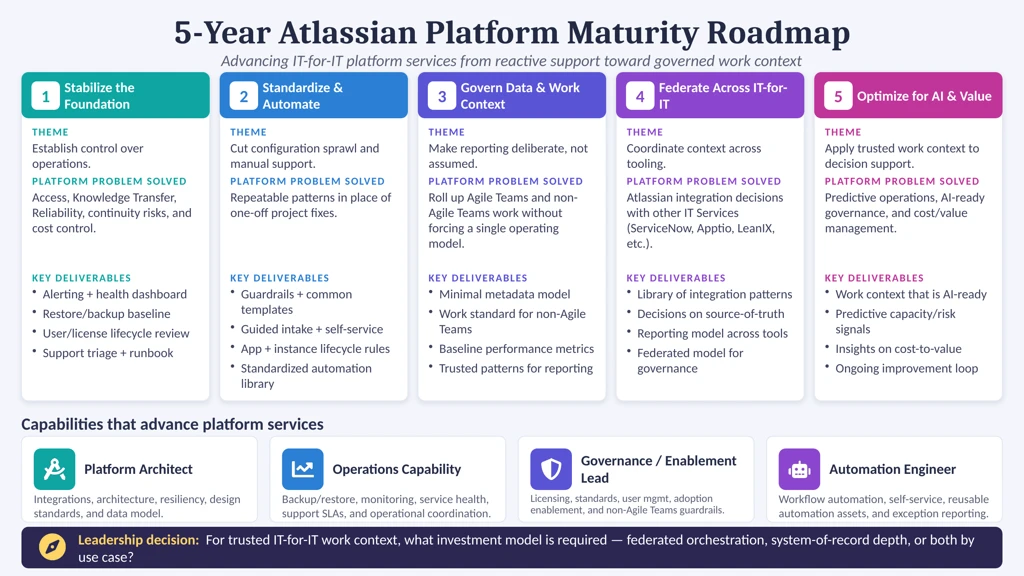
And that is the problem. The plan is impeccable and the strategy behind it is obsolete. It treats AI as the reward for four years of disciplined foundation work, the destination you earn after you’ve stabilized, standardized, governed, and federated everything first. In 2026, that sequencing doesn’t de-risk the outcome. It guarantees you will miss it.
Why a five-year (or one-year) maturity ladder is the wrong instrument now
The maturity-ladder model was designed for a world where the underlying technology moved slower than your ability to adopt it. Under that assumption, sequencing made sense: pour the foundation, then build up, because the ground wasn’t shifting while you worked. That assumption no longer holds.
Three things break it. First, the capability curve is faster than the plan. The AI tooling you’d anchor to in month one is unrecognizable within the year, so even a twelve-month plan bets on a model that’s obsolete before it ships, and a five-year plan locks in Year-1 assumptions only to pay them off in Year 5. Second, the foundation is now buyable, not buildable. Most of what stages 1–4 propose to construct internally (governed data context, cross-tool orchestration, reporting patterns) increasingly ships as a product or an agent you compose, not a multi-year internal program you staff. Third, the sequencing hides the value until the end. If AI value doesn’t appear until Year 5, the organization funds four years of cost before it sees a single dollar of return: the exact profile that gets cut in the first budget squeeze, leaving you with expensive foundation and no payoff.
Put plainly: a plan whose entire justification is “we’ll be AI-ready eventually” is spending real money now to be late later.
What a better plan must look like
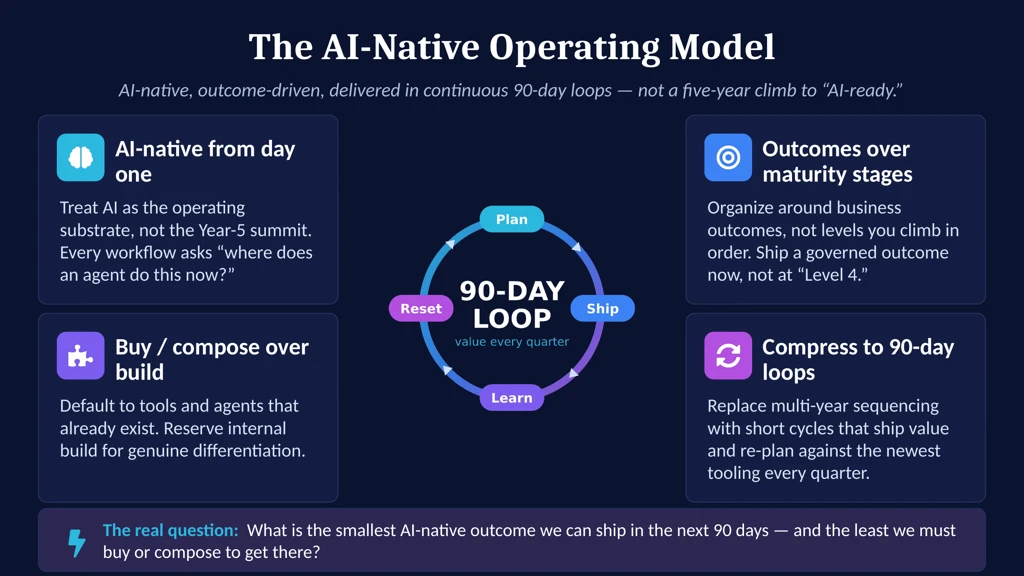
The alternative is not “no plan.” It is a plan built on four principles that assume speed, cheapness of capability, and continuous change.
AI-native from day one.
Treat AI as the operating substrate, not the summit. Every workflow in the plan should ask “where does an agent or model do this now?” from the first sprint, not defer that question to a future stage. The foundation you build should be the foundation an AI-native operation needs, not a pre-AI one you’ll retrofit later.
Outcomes over maturity stages.
Kill the linear ladder. Organize around business outcomes and the capabilities that serve them, not around “levels” you climb in order. Maturity stages measure how much you’ve built; outcomes measure whether anyone benefited. You do not need to be at “Level 4 Governance” to deliver a governed reporting outcome for one high-value use case now.
Buy and compose over build.
Default to leveraging tools, platforms, and agents that already exist. Reserve internal build for genuine differentiation. Every quarter you spend building undifferentiated foundation is a quarter a competitor spent composing it and shipping value on top.
Compress everything to 90-day loops.
Replace multi-year sequencing with short outcome cycles that ship value continuously and re-plan against the newest tooling every quarter. A 90-day loop can’t lock in obsolete assumptions; it’s too short to. Each cycle delivers a real outcome, banks the learning, and resets the plan against reality.
Old model vs. the bet worth making
| Dimension | Five-year maturity roadmap | AI-native, outcome-driven loops |
|---|---|---|
| Time to first AI value | ~Year 5 | Quarter 1 |
| Core assumption | Tech moves slower than adoption | Capability changes every quarter |
| Foundation | Built internally, over years | Bought/composed, continuously |
| Value realization | Back-loaded, cut-prone | Continuous, self-funding |
| Planning horizon | 5 years, fixed | 90 days, re-planned |
What this looks like in practice
One enterprise Atlassian estate we worked on had drifted to 1,800 custom Jira projects and a six-week manual reporting cycle — by any maturity model, a long way from “governed.” Collapsing that into 14 standardized templates and replacing the reporting cycle with real-time portfolio visibility did not require first reaching Level 4 of anything. It required deciding which outcome mattered and composing toward it. Read the case study.
The leadership decision, reframed
The original artifact ends by asking leadership to choose an investment model for “trusted work context”: system-of-record depth, federated orchestration, or both. That is the wrong question because it accepts the five-year frame. The real question is sharper: What is the smallest AI-native outcome we can ship in the next 90 days, and what is the least we must buy or compose to get there? Answer that four times a year and you will pass the five-year plan somewhere in its second stage, while it’s still buying cement.
Not sure what your 90 days should contain? Let’s talk.
Related reading
Why Your Jira Is Failing (AI Will Make It Worse)The same argument from the other direction: overbuilt platforms cannot bend to a faster way of working, and AI just made that fatal.
Two hours to find out whether we recognise your problem.
No deck, no obligation. We listen, we tell you whether we have seen this before, and we say what we think it would take. If a Jump Start is the right next step we will say so — and if it is not, we will say that too.