The Willingness Problem — part 1 of 3
AI Won’t Save You If You Can’t Change
Your biggest threat isn’t AI, it’s your comfort zone. The work itself has to change — this is about whether the organization is willing to.
Two hundred thousand miles from Earth, the Apollo 13 crew was slowly suffocating on its own exhaled carbon dioxide. The lunar module’s round scrubber canisters were spent. The command module had plenty of spares, and every one of them was square. The fix was a contraption of flight-manual cardboard, plastic bags, a suit hose, silver duct tape, and a sock stuffed into a vent hole to stop air bypassing the filter. It held. And the part worth remembering is not the duct tape. It is that the whole improvisation was designed and tested on the ground first, by an organization that knew its own systems cold, before a single astronaut was asked to build it.
That is the pairing companies keep failing to make with AI. Buying the tools is trivial. Rewiring the work is the hard part, and it only works when the people who keep things running and the people tearing things down are on the same crew. That is ChangeOps.
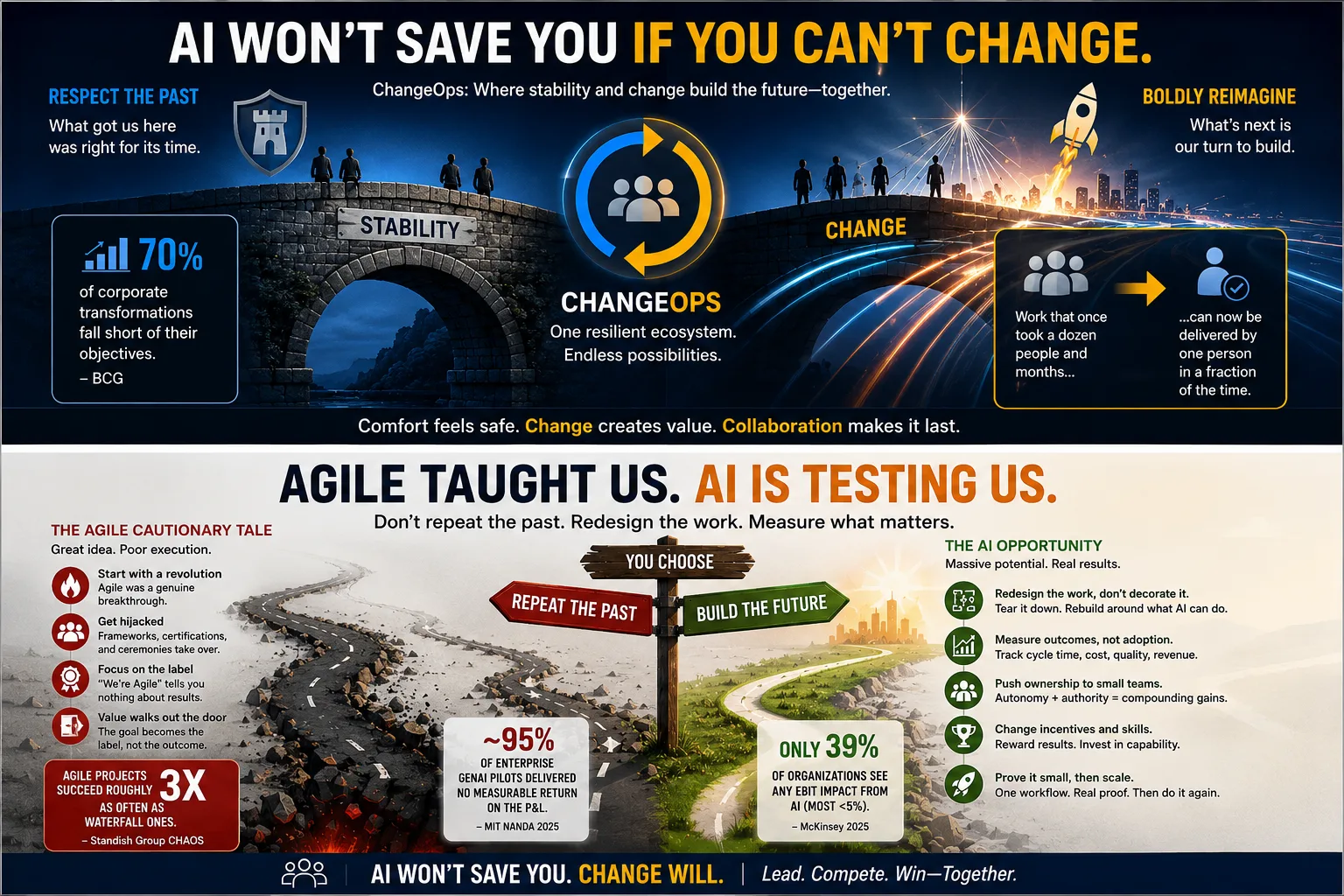
Your biggest threat isn’t AI. It’s your comfort zone. Human nature craves predictability, steady processes, and familiar tools, and the same comfort that once protected you quietly becomes the thing holding you back. This is measurable, not sentimental: BCG’s research on transformations finds that roughly 70% fall short of their objectives, and the deciding factor is usually not the technology. It’s the people dimension, meaning organization, operating model, and culture.
The DevSecOps movement already showed us the way out. Progress happened when those who valued stability and those who drove change stopped competing and started collaborating. ChangeOps applies that lesson to AI. It isn’t disruption for disruption’s sake, and it isn’t a reorganization. It’s integrating change agents and stability guardians into one resilient ecosystem, respecting the legacy of what was built before us while boldly reimagining what comes next. Those past systems weren’t “wrong.” They were right for their time. Now it’s our turn to build on that foundation for a more adaptive future.
We have also seen the failure mode before. Agile started as a revolt against process that smothered the work, and it delivered: the Standish Group’s 2015 CHAOS research found agile projects more than three times as likely to succeed as waterfall ones, with the gap widening as projects got bigger, which is exactly why it spread. Then it got hijacked by frameworks, certifications, and ceremonies that became status theatre, until “we’re Agile” told you nothing about whether a team could deliver. AI is retracing those exact steps, and the blast radius is far bigger because it reaches every job built on knowledge work, not just software. The hijacking has already begun: boardroom mandates to “adopt,” steering committees, thousands of tool licenses, and often very little to show for it beyond the bill.
What ChangeOps looks like in an AI world
Redesign the work, don’t decorate it. Most AI failures come from bolting a model onto a process built for humans doing every step by hand. Tear the workflow down to its purpose and rebuild it around what the tool can now do. The evidence here is blunt. MIT’s Project NANDA found that roughly 95% of enterprise generative-AI pilots delivered no measurable return on the P&L, despite an estimated $30 to $40 billion in enterprise spending, and MIT blamed neither the models nor the regulation. It blamed a “learning gap”: flawed workflow integration and adoption habits. McKinsey’s State of AI in 2025 shows the same thing from the other side. Only 39% of organizations report any enterprise-level EBIT impact from AI at all, most of that group sees less than 5%, and the high performers who do capture real value are nearly three times more likely to have fundamentally redesigned their workflows rather than decorated the old ones with an AI feature. Buying the tool and changing the work are two entirely different projects, and most companies only did the first. Ask “what would this look like if we designed it today?” not “where can we insert AI?”
Measure outcomes, not adoption. Don’t confuse enthusiasm with evidence. Most AI adoptions get measured in seats and logins, not in whether the work actually got better, faster, cheaper, or higher quality. Instead, track cycle time, cost per unit of work, output per person, quality, and revenue. Here is why that matters more than it sounds. In a randomized 2025 trial, METR found that experienced open-source developers took about 19% longer to complete tasks when AI was allowed, while believing they had worked about 20% faster. In METR’s February 2026 follow-up, the estimates flipped toward speedup (roughly 18% faster for the ten returning participants and 4% for 47 new recruits), but neither result was statistically clean, and METR reported that its own data had become an unreliable signal. A growing share of developers would no longer join a study that asked them to work without AI, and 30% to 50% of participants were withholding the very tasks they most wanted AI for. Because that selection runs in one direction, METR treats its estimate as a lower bound and believes the true gain is larger, while saying plainly that its data is only very weak evidence for the size of it.
The lesson for ChangeOps is not that AI fails to help. It does help. It is that neither enthusiasm nor usage will ever tell you how much, and the gap between “our people love it” and “our numbers moved” is precisely where transformations quietly die. If a research organization running controlled trials cannot size the effect, a dashboard counting logins has no chance. If you can’t point to a number that moved, you have a pilot, not a result.
Push ownership to small teams. The biggest gains show up when a small team can own a piece of work end-to-end, because AI collapses the coordination overhead that used to require a whole department. Autonomy is the multiplier, but only inside a culture where stability guardians trust the change and change agents respect what came before.
Change incentives and skills, or nothing changes. The people who got value from Agile changed how they worked; the rest just changed what they said in standup. Reward the teams that redesign, that ship more with less, that kill their own busywork.
Prove it small, then scale. The reckoning on company-wide AI programs is already forecast. Gartner projects that more than 40% of agentic-AI projects will be canceled by the end of 2027, sunk by escalating costs, unclear business value, and inadequate risk controls. The mandate that got the budget approved won’t be the one that saves the project. So pick one painful, high-value workflow, rebuild it, measure the before and after, and let undeniable results become the template for the next one.
All of it rests on one condition. Google’s Project Aristotle research on team performance ranked psychological safety, whether people feel safe taking interpersonal risks with each other, first in order of importance among the factors separating its highest-performing teams from the rest. That is the same thing that got a sock into a canister two hundred thousand miles from home: a room where the person with the strange idea and the person guarding the checklist could both speak, and neither had to win. It’s a mindset of mutual respect, where we continuously ask “why?” It’s where governance meets agility.
That’s how we lead, compete, and win — together.
Next in the series — Part 2: Why good transformation plans still fail (and the uncomfortable fix). Psychological safety is the ground you need. It is not sufficient, because some resistance is not a concern to be honored but a rejection to be found, and that is a harder conversation.
Two hours to find out whether we recognise your problem.
No deck, no obligation. We listen, we tell you whether we have seen this before, and we say what we think it would take. If a Jump Start is the right next step we will say so — and if it is not, we will say that too.