The Willingness Problem — part 2 of 3
Why Good Transformation Plans Still Fail (and the Uncomfortable Fix)
Continues the series on why organizations buy transformation and don’t get it — and what has to be true for the next attempt to land.
On December 23, 1954, at Peter Bent Brigham Hospital in Boston, a young surgeon named Joseph Murray moved a healthy kidney out of Ronald Herrick and into his dying twin brother Richard. It held. Richard lived another eight years, married one of his nurses, and had two children. The team had run seventeen tests, fingerprinting included, to confirm the brothers were truly identical, and that was the whole trick. The first successful organ transplant in history needed no anti-rejection drugs at all, because the new kidney was not foreign. Every transplant since has required the recipient’s own immune system to be deliberately suppressed. Not because the organ was flawed. Because the body attacks whatever it does not recognize.
That is the part leaders keep missing about transformation. Most transformations don’t die from a bad plan. They die from the people quietly waiting for them to fail, and from leaders unwilling to do anything about it. You can source the healthiest possible organ, match it perfectly, execute a flawless surgery, and the body will still try to reject it. Unless you are attempting a change so small the organization doesn’t notice it, the corporate equivalent of an identical twin, somebody has to do the uncomfortable work of suppressing the rejection.
I was recently asked what the hardest barriers are when companies of different sizes try to drive real change. Great question. The honest answer is a hard pill to swallow, because most leaders believe transformation is four things done well:
Make the case for why the change is good for the company (insert your buzzwords here).
Build a well-thought-out plan, often with a costly consulting firm that produces a shiny, exhaustive PowerPoint deck and says “go implement this.”
Roll the plan out from the top down, with leaders visibly bought in.
Bring in the “change agents” and expect the plan to work.
And yet most of these efforts fail, or move the needle only slightly, sometimes after years of trying. In many cases organizations make multiple multi-year runs at what is fundamentally the same change: the initiative gets rebranded, relaunched, versioned. 2.0. 3.0. Same destination, new logo.
You have heard that 70% of transformations fail. Be careful with that number, because its foundation is thin. When Mark Hughes went looking for the evidence behind it, he found no valid, reliable empirical basis for the figure at all, only one author citing another citing another. It survives because it feels true. What does hold up is the direction, and more importantly the cause. A peer-reviewed 2025 study of digital transformation projects puts the failure rate near 70% and states plainly that “the main failure factor is not caused by technological aspects, but by human and organizational factors.” Recent analysis in Forbes lands in the same place from the practitioner side, describing the barriers as behavioral rather than technical. So treat the statistic as folklore and the finding underneath it as solid: transformations fail on people, and we keep responding by building better plans.
Here’s what makes it maddening. Everyone agrees the change is good. The plan is clear and actionable. Leaders are aligned. It’s fully funded. Tracking is in place. Then, somewhere between one month and three years in, it fails anyway. Sometimes spectacularly.
Why?
Organizations have an immune system
Even in well-run companies full of talented, well-intentioned people, there is a force that will fight any change, whether it is good or bad, well-planned or not.
This is documented, not just a metaphor I happen to like. Harvard’s Robert Kegan and Lisa Lahey call it an immunity to change: alongside a sincere, stated commitment to change, people and organizations hold hidden competing commitments that quietly protect the status quo. One foot on the gas and one on the brake, and both feet belong to someone who will tell you, honestly, that they are behind the initiative.
And the rejection has layers.
The loudest resisters are the easy ones; they get reassigned or managed out. But they’re just the visible tip. For every vocal skeptic, there are ten or twenty more who say nothing and simply wait for the change to fail so they can return to the comfort of the old way. And beneath even them sits a quieter group that will actively undermine the effort, usually with fear, uncertainty, and doubt as their weapon of choice.
That silent middle layer is also getting bigger. Gartner research reported in Harvard Business Review found that employees’ willingness to support enterprise change fell from 74% in 2016 to 43% in 2022, while the average worker absorbed roughly ten planned changes a year, up from two. Your transformation is not landing on a neutral organization. It is landing on one that has been asked five times already and has learned, from experience, that waiting works.
None of this shows up on the project tracker. That’s exactly why it wins. Part 1 of this series makes a related argument about AI dashboards: the metrics most organizations watch are measuring the wrong thing. This is the sharper version of the same problem. The thing that kills your transformation isn’t being measured at all.
Turn this ship around
I often use another analogy to capture how hard this is at scale.
Picture a massive ocean liner or an oil tanker or a fully loaded cargo ship steaming across the ocean at full speed. The captain gets an order: change course, ninety degrees.
Can he just throw the rudder hard over and be done? Not even close. He needs the entire crew working in unison. The ship will lose speed; the drag of the turn slows it down even at full throttle. Will the cargo shift? Maybe. Can the hull even handle the maneuver at that radius? Maybe. So the captain weighs the risks: make the turn hard and fast in one mile, or ease into it over three, five, or more.
Now scale that up. A ship is dozens of people. An organization is thousands or tens of thousands of individuals, each with their own priorities, incentives, and their own read on whether this change is worth their effort. Aligning all of them is the actual job. The PowerPoint is not.
So what actually works?
Is it possible to drive a transformation that succeeds even when every “correct” step has been taken and it’s still heading for the rocks? From my experience: absolutely, yes. But it isn’t easy, and there’s no silver bullet.
Go back to the transplant. When the body can’t accept a new organ on its own, doctors don’t just hope harder, and they don’t go looking for a better organ. They introduce targeted treatment to suppress the rejection and give the organ time to take. An organization in the middle of real change needs the same thing. Not more slides. The right people, placed deliberately.
This is where I need to draw a sharp line, because I just criticized the consultants’ “change agents.” The difference matters. The typical change agent arrives to administer the plan: track adoption, run the workshops, report status up the chain. The people I’m describing do something else entirely. They embed into the actual work, at multiple levels and across functions, and their job is to help the change take root by finding and neutralizing the rejection before it kills the transplant.
That distinction is not just my preference. McKinsey’s research on transformations finds they succeed far more often when a committed core and a network of embedded influencers carry the change than when it arrives as a top-down mandate. Which is to say: the immunosuppression has to reach the tissue. Announcing it from the podium does nothing.
To do that, these people have to possess a unique and specific mix of qualities:
They fully understand the goals of the transformation. Not the slogan, the substance.
In their domain (Engineering, IT, HR, Finance, and so on) they are seasoned subject-matter experts who earn credibility on day one.
They have strong communication skills and know how to influence indirectly, without a title telling people to listen.
They are connected, to each other and to the leadership team driving the change, so the effort moves as one system rather than scattered pockets.
They can recognize the resistance for what it is and root it out quickly.
The part nobody wants to do
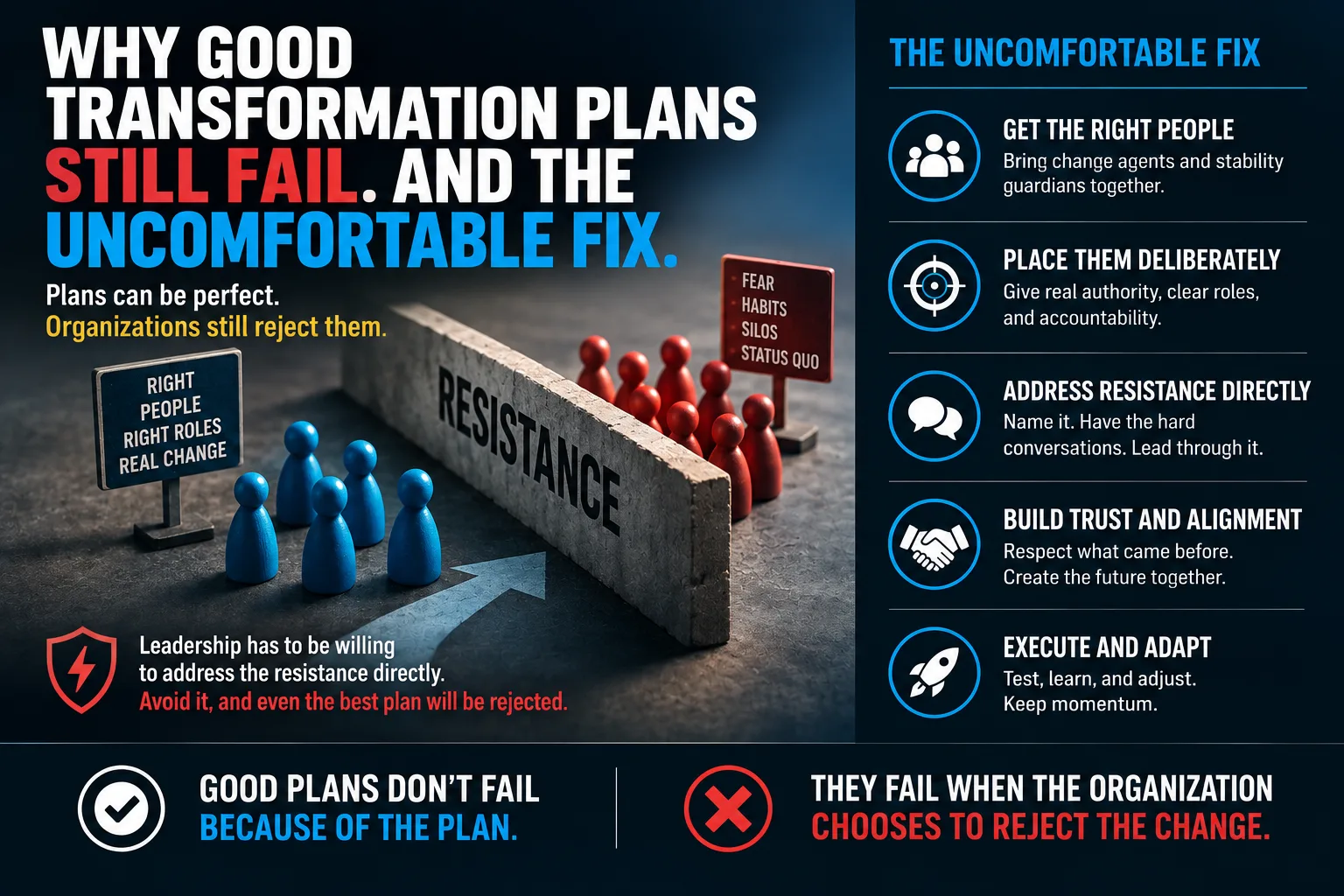
Here’s the piece that makes or breaks everything: leadership has to be willing to address the resistance directly.
Part 1 of this series argues for psychological safety, and I stand behind it: you cannot rewire the work without a room where the person with the strange idea and the person guarding the checklist can both speak. But safety is the ground you build on, not the whole building. Some resistance is a legitimate stability concern that deserves respect, and some of it is rejection. Telling those apart, and then acting, is where this gets uncomfortable.
Sometimes that’s straightforward. A firm, honest conversation with the individual(s) and their manager, making clear that the old way is no longer an option. That works more often than people expect; when they see the status quo genuinely end, many people adapt. Others need coaching or training to get on board, and that’s worth investing in. But for those who won’t adapt, after a fair chance, real support, and enough time, the answer is that they need to leave the organization.
There is a reason this sits with leadership and not with the program office. The same McKinsey work found that executives who invest early in shifting employee mindsets are four times more likely to call their change programs successful, and noted plainly that employees notice when their bosses don’t change their own behavior. The organization is reading you, not the plan.
For a lot of leaders, the actions I just described are deeply uncomfortable. And that discomfort is precisely where most transformations quietly die. Not because the plan was weak or the people driving it were incompetent, but because no one looked for the rejection, and/or no one was willing to act on it when they did see it.
Real world evidence
I’ve seen many transformations collapse because the organization was unwilling to do the really hard part, usually after spending crazy amounts of money, from millions to tens of millions. Was some value derived? Sure. But the ROI was nowhere near what the plan promised. Not even close.
I’ve also been part of many successes, most of them after multiple failed attempts. These succeeded because the people we engaged with understood up front that something different had to happen this time. One leader, a CIO, flat out told me: “I’m a visionary. I don’t have the stomach for the hard part.” Fair enough. People are who they are, and the best leaders recognize when they need help. Our solution was to facilitate the hiring of someone who could execute and own the job of finding and fixing the places where people were trying to reject the new organ. That person’s title? Co-CIO. That alone tells you how humble and self-reflective the existing CIO was. In the end, that multi-year transformation cost several million dollars and delivered a measured, roughly 2.5x return over the initial predicted saving.
The lesson here is not “hire a Co-CIO.” It’s that the best leaders know which part they can’t personally do, and they get out of its way. Sometimes that’s all it really takes.
So far in this series the demand has been the same one, and it has never been about tooling. Part 1 asks for the willingness to let someone else’s priorities be legitimate. This part asks for the willingness to act when you find people quietly waiting for the whole thing to fail. There was never a healthier organ to go find. There was only ever the rejection, and whether anyone was willing to treat it.
Next in the series — Part 3: Your AI Roadmap Is Already Obsolete. Willingness is not the only way a transformation goes wrong. The plan itself can be built on a horizon that has already closed.
Are you in the middle of a change or transformation right now? What kind? Is it going the way it was planned? If not, what’s really getting in the way?
I’d genuinely like to hear it. Let’s talk.
Two hours to find out whether we recognise your problem.
No deck, no obligation. We listen, we tell you whether we have seen this before, and we say what we think it would take. If a Jump Start is the right next step we will say so — and if it is not, we will say that too.